This is the story of my homemade metal melting furnace
Why did I build one? - I needed the ability to make my own castings to my own designs and in small quantities (often one off's), no local foundries would do castings in one off's for less than £200, virtually no commercial foundries use loose patterns and they are loosing the skills to do so, so in a way I'm trying to keep what is rapidly becoming a cottage craft going.
Where did it all start
I suppose I have always wanted to make castings, I have always enjoyed working with metal, I recently discovered the wealth of information on the web about hobby casting and I thought why not fill that corner in the garage.
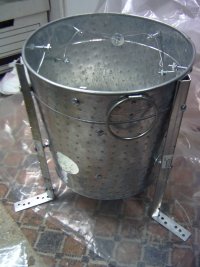
This is the galvanised steel planter I used for the furnace shell. The three legs were made from beam hangers and joist supports from my local builders merchants. The inside of the shell was wired to help strengthen the refractory ( in hindsight this was probably a mistake as it would be impossible to remove the refractory later on should it need repair).
The hole was cut off centre for the burner and the base was cast, ( with a 1" dowel through the bottom of the planter - drain hole! ), once the base had set but not dried a large former ( 8" plastic paint tin ) well wrapped in polythene was placed into the shell, a wooden former cut to form the burner hole was inserted up to the paint tin and the end stuck with gaffer tape to help form a nice radius into what will become the combustion chamber. More refractory was mixed up to manufacturers instructions and tamped into the void between the former and shell. Once complete the whole thing was wrapped in bubble wrap and sealed to keep the moisture in and left for a week.
Time passes .......
All the formers were eventually removed with great difficulty and a small 30W heater was inserted into the new cavity, wrapped in bubble wrap again but with some air holes to allow air to circulate.
A Week later .....
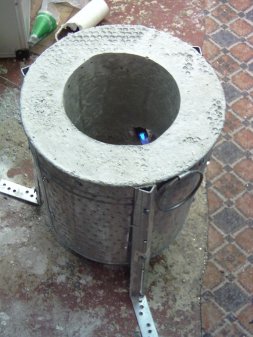
The furnace shell is starting to show signs of drying out, here a small blowtorch is being used to help raise the temperature, it was soon very evident that the furnace would have a massive thermal inertia and would take ages to dry out like this so the furnace shell along with the lid that was cast ( sorry no pictures at this stage ) was put aside in the garage and work was started on the BURNER to fire the furnace.
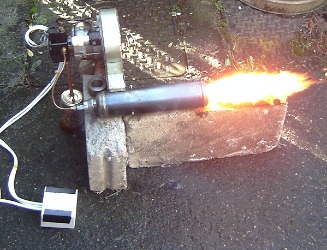
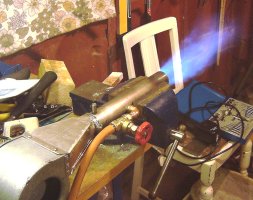 the burner is undergoing its first test run. It is basically a 80 cubic feet per minute blower and a venturi gas mixer, there is a butterfly valve just after the blower so that the airflow can be regulated and the low pressure gas feed can be regulated by the gate valve. The perspective of this picture does not do the flame justice, it was about 20" long and the radiated heat was immense.
The 'burnout' procedure supplied by the refractory manufacturer must be followed to the letter, doing it too quickly can cause a very dangerous steam explosion. Even following the procedure the furnace shell hissed like a pressure cooker, not a pleasant experience at all, after about 12 hours of intermittent heating there were no signs of water or steam ( during the heat up procedure water is forced out of the cement bond forming a hard white ceramic ).
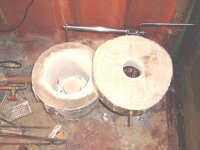 This last picture shows the furnace with its lid after the burnout procedure is complete. The lid runs horizontally onto a steel support when open, so that the hot face of lid is not up facing the user, also means that metal may be placed on the lid to pre-heat without having to remove it prior to opening the furnace.
The furnace has been in intermittent use now for three years since being built and is as yet showing no signs of wear, the refractory is still good and shows no signs of deteriorating.
To see what I've cast for myself, look at the foundry projects on the left navigation pane below 'DIY Foundry'.
I did have a go at producing an oil fired burner that used a high pressure diffuser to atomise the fuel oil ( diesel heating oil ) but the carbon deposits that this created and the smell as the furnace heated from cold were quite alarming, and not something that I wanted to share a space with. This original furnace was decommissioned back in 2020 with the move over to investment casting.